The Prestige Standard stone-care team · Published 5 November 2026 · Updated 5 November 2026 · 10 min read
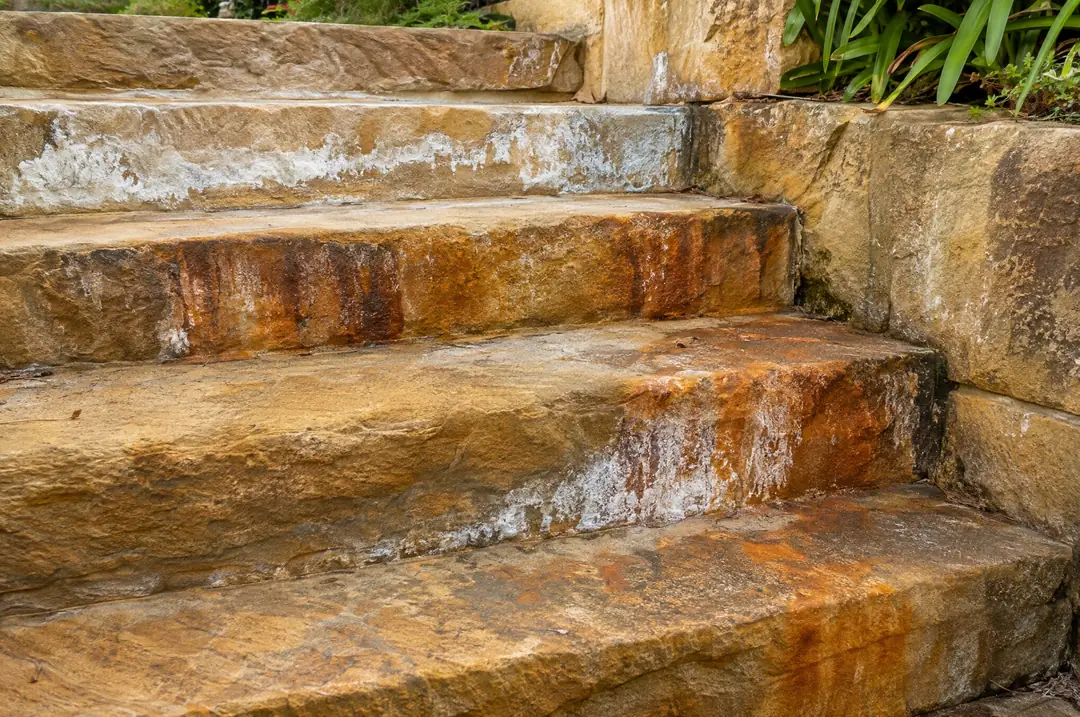
Where rust stains on sandstone come from
Orange-brown staining on sandstone almost always means iron oxide, but the iron can come from two very different places: from something sitting on or fixed into the stone, or from inside the stone itself. Working out which one you are dealing with decides everything that follows.
Iron that is already in the stone
Sydney's Hawkesbury sandstone is made mostly of quartz grains held in a clay-rich binder, with a small and variable amount of iron-bearing minerals, including siderite. As those minerals weather and oxidise, they give the stone its warm honey, ochre and rust-coloured banding. That banding is part of the stone's character and is not a stain. Problems start when water, salts or cleaning chemicals mobilise the iron and redeposit it unevenly at the surface, leaving blotches, tide-marks or orange halos that don't follow the natural bedding.
Iron from fixings and steel
Steel bolts, balustrade spigots, gate hinges, downpipe brackets and old wall ties all corrode over time, and the run-off carries iron down the face of the stone. These stains usually sit directly below the metal and fan out in the direction the water runs. Where steel is set inside the stone, rust can also expand and crack it, which is a repair issue rather than a cleaning one.
Fertiliser and garden products
Lawn and garden fertilisers that contain iron, including iron sulphate products used to green up lawns, leave speckled orange marks where granules land on paving and are then wetted by dew or irrigation. The pattern gives it away: many small dots, heaviest along lawn edges and garden beds.
Furniture, pots and everyday objects
Metal furniture feet, pot stands, barbecue trolleys, bikes, tools and even a forgotten tin can leave crisp rust outlines in the shape of the object. Steel wool and wire brushes used on the stone leave tiny metal fragments that rust later, and sparks from angle grinders used nearby can embed specks of hot steel in the surface.
| What you see | Likely source | First step |
|---|---|---|
| Streaks running down from a bolt, rail or bracket | Corroding steel fixing | Fix or replace the metal before treating the stain |
| Crisp ring or foot-shaped marks | Furniture, pot stands, tools | Move the object, add glides or saucers, then treat |
| Fine orange speckles near lawn or beds | Iron-containing fertiliser | Sweep up granules dry, then treat |
| Blotchy orange patches after a clean | Iron mobilised from the stone, often by acid | Stop using the product and get advice before trying anything else |
| Orange halo around a crack or spall | Rusting steel inside the stone | Have the stone and fixing assessed |
| Even, layered orange and ochre bands | Natural iron in the stone | Leave it. This is the stone's colour |
Is it rust, or something else?
Several other marks on sandstone can look like rust at a glance. Before treating anything, check the following.
- Tannin stains from leaves, bark and timber are usually brown rather than orange, sit where organic matter has lain, and often fade with time and sun.
- Orange lichens grow as raised, crusty rosettes, particularly on coastal stone. Rust is flat and sits in the stone, not on it.
- Natural iron banding follows the layers of the stone and runs across several pieces in a consistent direction. It should be preserved, not removed.
- Efflorescence is white and powdery, though it can carry dissolved iron and show a faint orange tinge where it dries. Our guide to efflorescence on stone pavers explains how to handle it.
The Natural Stone Institute's stain guidance makes a useful point: iron stains tend to be orange to brown and follow the shape of the object that caused them. If the shape tells a story, it is probably an external source. If the colour has no clear origin and appeared after cleaning, suspect iron from within the stone.
Why acidic rust removers can make sandstone worse
Most of the rust removers on hardware shelves rely on acid. On steel, ceramics and some dense stones that works well. On sandstone it is a gamble, for three reasons.
- The stone has its own iron. Acid doesn't only dissolve the rust you want gone. It can also attack the iron-bearing minerals in the stone and bring them to the surface. Gosford Quarries, a Sydney sandstone supplier, warns that hydrochloric acid can draw iron deposits to the surface and change how the stone looks.
- The binder is vulnerable. The clay and mineral cement that holds the quartz grains together is the weak part of sandstone. Acids can loosen it, roughening the surface and leaving it more absorbent than before.
- Acids leave salts behind. Heritage guidance first published by the Heritage Council of NSW, and later adapted by Heritage Victoria, notes that acids can cause bleaching and uneven iron oxide colouring in sandstone, and that acid residues can form salts which crystallise in the pores and decay the stone.
The result we see most often is a small, crisp rust mark turned into a larger, blotchy orange patch with a bleached rim. That is much harder to treat than the original stain.
Manufacturers are candid about this in their own literature. Lithofin's non-acidic Rust-Ex, for example, lists ferrous natural stones among the surfaces whose colour may change, and tells users to test first. Prosoco's acidic Ferrous Stain Remover is rated for unpolished sandstone but warns that it may alter masonry colour and must be trialled on a sizeable test area. FILA separates its acidic descaler from a non-acidic rust remover intended for sensitive stone.
None of this means acid is never used. Conservation guidance does describe carefully diluted reagents for iron staining in specific cases. The difference is control: a trained operator choosing the reagent for the stone, pre-wetting, limiting dwell time, neutralising and rinsing, and judging a test patch after it has fully dried. That is specialist work, and not something to try on a front step with a bottle from the hardware store.
How a poultice draws rust out of stone
Because sandstone is porous, rust is rarely just on the surface. It has been carried into the pores by water. Scrubbing the face only lightens the top layer, and the stain often wicks back as the stone dries. A poultice works the other way round.
A poultice is an absorbent paste, usually a fine white clay, diatomaceous earth or paper pulp, mixed with a reagent chosen for the stain. It is spread over the mark and left to dry slowly. The reagent loosens the iron, and as the paste dries it draws moisture, and the dissolved iron with it, out of the stone and into the poultice. When the dry poultice is removed, the stain comes away with it.
The published methods agree on the essentials:
- Pre-wet the stone with clean water so the reagent stays near the surface instead of soaking deep into dry pores.
- Apply a thick, even layer, typically several millimetres deep and spread well past the edges of the stain, so the stain is drawn into the poultice rather than pushed outwards into clean stone.
- Cover and wait. Plastic sheeting taped at the edges slows drying, giving the reagent time to work. Depending on the product, poultices are commonly left for one to two days.
- Remove with a plastic or timber scraper, rinse thoroughly and let the stone dry completely before judging the result.
- Repeat if it is working. The Natural Stone Institute notes that stubborn stains can take several applications, and that some deep stains may never lift completely.
Two further points matter on sandstone. The poultice material has to suit the reagent, since some clays contain iron or react with acidic chemicals and cancel each other out. And the surrounding stone needs protecting, because chemistry that runs onto clean stone can discolour it or drive the stain deeper.
| Approach | Good for | Risk on sandstone | Our view |
|---|---|---|---|
| Dry brushing and scraping off loose rust | Fresh surface deposits | Very low with a soft or nylon brush | Always the first step |
| Non-acidic rust remover labelled for natural stone | Light, recent marks from furniture or fertiliser | Low to moderate; colour change possible on iron-rich stone | Reasonable DIY option after a test patch |
| Rust poultice with a stone-specific reagent | Older, deeper and larger stains | Low when correctly matched and rinsed | Our main method |
| Hardware-store acid rust remover | Steel, ceramics, some dense stone | High: iron release, bleaching, salts | Avoid on sandstone |
| Hydrochloric acid or brick cleaner | Mortar residue on brick | High: binder damage and orange blooms | Do not use |
| Wire brush, steel wool or grinding | Nothing on stone | High: scarring and new rust from metal fragments | Do not use |
What you can safely do yourself
Small, recent rust marks from furniture or fertiliser on sound, unsealed paving are often within a careful homeowner's reach. Older stains, large areas and anything you suspect is coming from inside the stone are better left to a specialist. If you want to try, this is the sequence we would follow.
- Remove the source. Move the furniture, replace the corroding fixing, or sweep up fertiliser granules while they are dry. Treating a stain while its cause is still in place only buys a few weeks.
- Brush off loose rust dry. Use a nylon or natural-bristle brush and a plastic scraper. Never use steel wool or a wire brush.
- Choose a non-acidic product made for natural stone. Read the label for the stones it suits and the ones it doesn't. If the label says it suits acid-resistant surfaces only, or lists sandstone as a stone that may discolour, take that seriously.
- Test in an inconspicuous spot. Follow the label's dwell time exactly, rinse thoroughly, then let the test area dry for at least a day. Sandstone looks very different wet and dry.
- Treat the stain, not the whole area. Apply only to the mark, don't let the product dry on the stone, and rinse well afterwards.
- Manage the run-off. Keep rinse water out of gutters and stormwater grates. In NSW the stormwater system is for rain only. Our regulations page explains the rules.
- Stop if it spreads. If the stain grows, blurs, bleaches or turns more orange, stop. Further attempts usually make it harder to fix.
A word on homemade remedies. Lemon juice and vinegar are acids and carry the same risks as commercial acid cleaners, just more slowly. Bleach does nothing useful to iron and adds salts to the stone. Online advice that works on concrete or porcelain doesn't transfer to sandstone.
Stopping rust stains from coming back
A rust stain is a symptom. Once it has been removed, the aim is to make sure the conditions that caused it don't return.
- Use stainless or isolated fixings. When balustrades, gates or lights are fixed into sandstone, ask for marine-grade stainless steel and isolation from the stone where practical. Existing mild-steel fixings that are bleeding can often be replaced.
- Fix the water path. Rust stains spread where water runs. Leaking downpipes, overflowing gutters and irrigation spray all move iron across the stone.
- Use glides and saucers. Plastic or felt glides under metal furniture, and saucers with feet under pots, keep wet metal off the stone.
- Spread fertiliser carefully. Keep granules off paving, sweep up spills before they get wet, and water lawns so the spray doesn't drift onto the stone.
- Keep metalwork off the stone during trades. Ask builders, landscapers and pool installers not to grind, cut or store steel on or beside finished sandstone.
- Consider a penetrating sealer. A breathable impregnator won't stop rust forming, but it slows absorption so marks sit closer to the surface and are easier to treat. Our guide Does sandstone need sealing? covers when sealing is worthwhile.
When to call a specialist
We recommend getting professional help when:
- the stain is old, large, or has been there through several wet seasons;
- it has appeared or spread after acid cleaning or a DIY rust remover;
- it surrounds a crack, a spall or a fixing set into the stone;
- the stone is soft, sandy, flaking or heavily weathered;
- the sandstone is sealed or coated, since many stain treatments need the sealer removed locally and re-applied;
- the property is heritage-listed or in a heritage conservation area, or the stone is carved or historic.
Heritage stone deserves particular care. Councils differ in how they treat cleaning and restoration of heritage fabric, so check before work starts. Our guide to heritage sandstone cleaning in Sydney explains what to ask.
A specialist won't make every stain vanish. What they can do is identify the stain correctly, choose a reagent and poultice suited to sandstone, test it, and tell you honestly what to expect before committing to the whole job. Deep or long-standing iron staining often lightens considerably without disappearing completely, and it is better to know that at the start.
What professional rust removal involves
Our stone stain removal service follows the same order every time.
- Inspect. We map the stains, identify the likely source for each one and check whether the stone is sealed, coated or damaged.
- Deal with the cause. Corroding fixings, leaking downpipes and irrigation problems are flagged so they can be fixed by the right trade before or alongside the stain work.
- Test. A small poultice trial on a representative stain, judged once dry, confirms the reagent and dwell time.
- Poultice. The full treatment, repeated where it is working but not yet finished. Surrounding stone, plants and metalwork are protected.
- Neutralise, rinse and recover. Residues are removed and wash water is captured rather than sent to the drain.
- Protect. Once the stone is dry, an optional penetrating sealer, matched to any existing treatment, so the area weathers evenly with the rest.
Where rust has cracked or spalled the stone, sandstone restoration may be needed as well, and if the whole surface is grimy, a gentle sandstone clean first gives a more even result. Our guide to cleaning sandstone covers the basics. We work across the Eastern Suburbs and Northern Beaches, and you can send photos through our contact page for an initial view.
Sources
- Heritage Victoria: Cleaning masonry (adapted from Heritage Council of NSW, Cleaning Masonry Walls)
- U.S. General Services Administration: Poulticing rust stains from limestone and marble
- Natural Stone Institute: Stain identification and removal
- Gosford Quarries: How to clean sandstone
- Lithofin: Rust-Ex technical information
- Prosoco: Ferrous Stain Remover product data
- FILA: What to do if there is rust on natural stone
- FILA: How to remove rust and sulphate stains from natural stone paving
- Wikipedia: Hawkesbury Sandstone (composition)