The Prestige Standard stone-care team · Published 5 November 2026 · Updated 5 November 2026 · 8 min read
Know the stone before you clean it
Most of the sandstone around Sydney homes is Hawkesbury sandstone, either quarried locally or reclaimed from the city's older buildings. It is made largely of quartz grains held together by a much softer natural binder of clay and iron-bearing minerals. The quartz is hard; the binder is not. That single fact explains why sandstone behaves so differently from concrete, granite or porcelain when you start cleaning it.
Exposed sandstone also develops a slightly firmer weathered skin over the years. It is part of the stone's character, and it protects the softer material behind it. Good cleaning removes what sits on that skin. Poor cleaning removes the skin itself, and once it has gone the surface is rougher, more absorbent and quicker to collect dirt and growth than it was before.
Finally, sandstone is porous. Water, dissolved salts and cleaning chemicals soak in rather than sitting on top, so whatever you put on the stone can stay in the stone. Keep that in mind with every product you consider.
The iron in Sydney sandstone is also what gives it the honey, ochre and rust-coloured banding owners love. Cleaned properly, that banding comes back. Cleaned badly, the same iron can bleed out as blotchy orange staining that is far harder to fix than the original dirt.
Identify what you are cleaning off
Before choosing a method, look closely at the soiling. A single grey-black wall can carry several different things at once, and each one responds to a different treatment.
| What you see | Where it tends to appear | Gentlest effective approach |
|---|---|---|
| Black, green or grey growth (mould, algae, lichen) | Shaded, damp or south-facing stone, often worse after a wet winter | Stone-safe biocide left to dwell, then soft brushing and a low-pressure rinse |
| General dirt and traffic grime | Paving, steps and entries | Water, a pH-neutral stone cleaner and a soft or natural-bristle brush |
| Brown leaf and tannin marks | Under trees and wherever wet leaves sit | Prompt sweeping and a stone-safe cleaner; a poultice for older marks |
| Oil, grease and food marks | Barbecue areas, outdoor kitchens, driveways | A degreaser suited to stone, or a solvent poultice |
| Orange-brown rust | Around metal fixings, furniture feet and fertiliser spills | A stone-specific rust poultice; usually a specialist job |
| White powder or crust | Lower walls, retaining walls, paving near pools | Usually efflorescence: dry brushing first, then deal with the moisture |
If a mark doesn't fit neatly into one row, or you can't tell whether it is dirt or damage, test before you treat. Our guides to removing black mould from sandstone and efflorescence on stone pavers cover the two most common problems in detail.
Start with the gentlest method that works
Australian heritage guidance on cleaning masonry has been consistent for decades: begin with water. The Heritage Council of NSW's advice on cleaning masonry walls, later adapted by Heritage Victoria, describes plain water and a firm natural-bristle brush as the simplest and safest starting point, moving from cold to warm water only if needed. It also recommends trialling any method on a representative patch of roughly one to two square metres, beside an uncleaned area, so you can compare the result fairly.
The same guidance is cautious about pressure. A controlled, wide fan of water can be acceptable on sound stone, but softer stone and mortar joints can be damaged even at modest pressures, and abrasive or high-pressure methods can harm weak surfaces and carved detail. Sydney sandstone supplier Gosford Quarries gives homeowners similar advice: low pressure only, because a stronger jet breaks particles away from the face of the stone.
We treat that as a working rule on every property, whether it is a heritage terrace in Paddington or a new sandstone pool terrace in Seaforth. If water and a brush will do the job, nothing stronger is needed. If they won't, the next step is the right chemistry and a longer dwell time, not more force.
What not to use on sandstone
Much of the damage we are asked to repair was caused by cleaning, usually with good intentions. These are the usual culprits.
- Hydrochloric acid and brick cleaners. Mineral acids attack the binder in sandstone and can mobilise the stone's natural iron, leaving orange-brown blooms that are harder to remove than the original grime. Heritage Victoria's guidance does not recommend mineral acids for sandstone and notes that acids can leave salts behind in masonry.
- Vinegar. It is a weak acid, but still an acid. Sandstone suppliers advise against it, and it can also weaken an existing sealer.
- Household bleach. It may lighten black marks quickly, but it introduces sodium salts into a porous stone, can bleach the surface unevenly and is hard on the garden beds below. NSW heritage guidance lists cleaning compounds that contain or form salts among the sources of salt damage in masonry.
- High-pressure tips and turbo nozzles. They cut into the binder and strip the weathered skin, leaving pale stripes and a furry, sanded texture. Historic England's research notes that aggressive methods such as high-pressure jets roughen masonry surfaces, and rough stone collects dirt and growth faster.
- Wire brushes and abrasive pads. They scour the surface unevenly and can leave steel fragments behind that later rust.
| Method | Risk to the stone | Our view |
|---|---|---|
| Water and a soft or natural-bristle brush | Very low | Always the first step |
| pH-neutral stone cleaner | Low | Good for routine dirt and grime |
| Stone-safe biocide with dwell time | Low when used to the label and rinsed or left as directed | The right tool for mould, algae and lichen |
| Low-pressure soft wash or controlled hot water | Low to moderate; depends on the operator | Effective after treatment, in experienced hands |
| Bleach | Moderate: salts, uneven bleaching, plant damage | Avoid on large areas |
| Household pressure washer with a narrow tip | High: permanent erosion | Not recommended |
| Hydrochloric acid or brick cleaner | High: iron staining, binder loss, salts | Do not use |
A safe DIY clean, step by step
For routine dirt and light growth on sound paving or steps, a careful homeowner can get good results. Pick a mild, overcast day so the stone doesn't dry too quickly, and allow a few unhurried hours.
- Clear and protect. Sweep or blow off leaves and loose debris. Wet down nearby plants and cover anything you don't want splashed.
- Plan the run-off. Decide where the water will go before you start. Keep it away from gutters and stormwater grates and, where the product label allows, direct it onto lawn or soil.
- Test a small patch. Try your method somewhere inconspicuous and let it dry completely before judging. Sandstone looks very different wet and dry.
- Pre-wet the stone. Dampening the surface first reduces how deeply cleaning solution is drawn into the pores.
- Apply a pH-neutral stone cleaner diluted as the label directs, and give it a few minutes to work. Don't let it dry on the surface.
- Agitate gently with a soft or natural-bristle brush or broom.
- Rinse thoroughly with a garden hose, or a wide fan at low pressure held well back from the surface.
- Let it dry, then assess. Give it a day or two of fine weather before deciding whether a second pass, or a specialist, is needed.
For mould and lichen, a stone-safe biocide used exactly as labelled is a reasonable DIY option on paving and low walls. Leave-on products work slowly as rain and sun break down the dead growth, which suits patient owners. Wear gloves and eye protection, read the safety data sheet, and never mix cleaning products.
Different surfaces need different care
Paving and steps
Horizontal stone takes the most traffic and holds water the longest. Clean it often enough that grime never builds up, and keep leaves off it. Steps deserve extra attention, because growth on a step is a slip risk as much as a cosmetic one.
Walls, retaining walls and gate piers
Vertical stone usually needs less cleaning than people expect. Avoid soaking walls that already show damp or white salt at their base, because extra water feeds the problem. If a wall stays green or black, the real fix is usually the moisture source: a leaking downpipe, a garden bed built against the stone, or sprinklers hitting it daily.
Pool coping
Keep every cleaning product out of the pool, and rinse salt water off coping regularly with fresh water. Coping is the hardest-working stone on most properties, and our pool coping service is built around it.
Heritage, carved and fragile stone
Older facades, carved detail and soft or flaking stone are best left to specialists. If your home is heritage-listed or in a heritage conservation area, check with your council before significant cleaning works. Our regulations page explains where to start.
Where the wash water goes
Wash water from stone cleaning carries dirt, dead growth and whatever product you used. In NSW the stormwater system is for rain only; the NSW EPA's guidance is that the drain is just for rain. Stormwater is not treated before it reaches creeks, the harbour and the ocean, and causing or permitting water pollution is an offence under the Protection of the Environment Operations Act 1997. NSW council guidance applies this directly to washing work, including high-pressure cleaning: run-off must not enter stormwater drains.
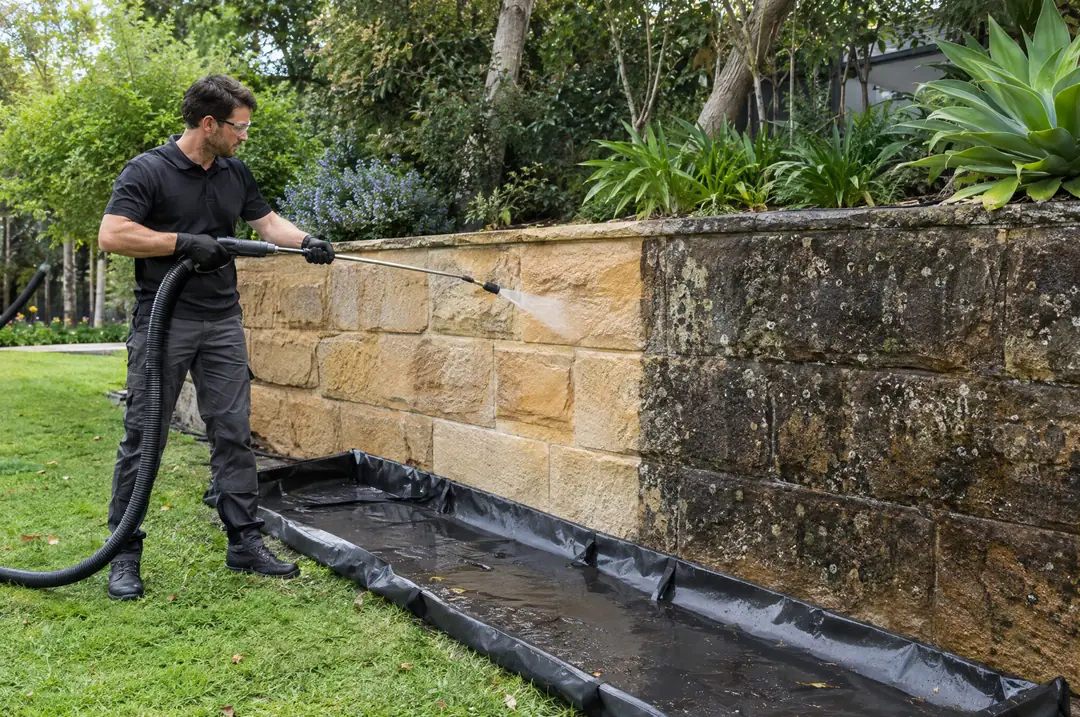
For a small DIY job with water and a mild cleaner, that usually means steering run-off onto lawn or soil and away from the gutter. On larger jobs, and on any job using biocides, we bund the drains and vacuum-recover the wash water so it can be disposed of properly.
When to call a specialist
Some sandstone cleaning is well within a careful homeowner's reach. Some is easy to make worse. We suggest calling a specialist when:
- the stone is soft, sandy, flaking or crumbling;
- there is rust staining, deep oil, paint or graffiti;
- an old coating is peeling, patchy or yellowed;
- the area is large or high, or drains towards a pool, garden or neighbour;
- the property is heritage-listed or the stone is carved or historic;
- growth returns within months of every clean.
Our sandstone cleaning service starts with a test patch and an identification of what is actually on the stone, then uses biocide treatment, low-pressure rinsing and full run-off recovery. Where the problem is inside the stone rather than on it, sandstone restoration or stain removal is the better fit. We work across the Eastern Suburbs and Northern Beaches with vetted, insured technicians.
After cleaning: drying, sealing and upkeep
Freshly cleaned sandstone needs time to dry out before anything else happens. If you plan to seal, wait for several days of fine weather, because sealing damp stone traps moisture inside it. Whether sealing is worthwhile depends on where the stone is and how it is used, which we cover in Does sandstone need sealing?.
Between cleans, a little routine goes a long way. Sweep leaves before they stain, trim plants that keep stone permanently shaded and wet, rinse salt spray off coastal paving, and use a pH-neutral stone cleaner instead of general household products. Stone that is looked after this way rarely needs anything stronger.
Sources
- Heritage Victoria, Cleaning Masonry (2001), adapted from the Heritage Council of NSW's Cleaning Masonry Walls
- Heritage NSW, Heritage maintenance: Cleaning masonry walls (Information sheet 6.1)
- David Young, Salt Attack and Rising Damp: A guide to salt damp in historic and older buildings (Heritage Council of NSW and partners, 2008)
- Gosford Quarries, How to clean sandstone guide
- Historic England, Control of biological growth on masonry (research summary)
- NSW Environment Protection Authority, Best practice stormwater management (2023)
- Wollondilly Shire Council, Water Pollution Prevention Fact Sheet (Protection of the Environment Operations Act 1997)