The Prestige Standard stone-care team · Published 5 November 2026 · Updated 5 November 2026 · 8 min read
What efflorescence is
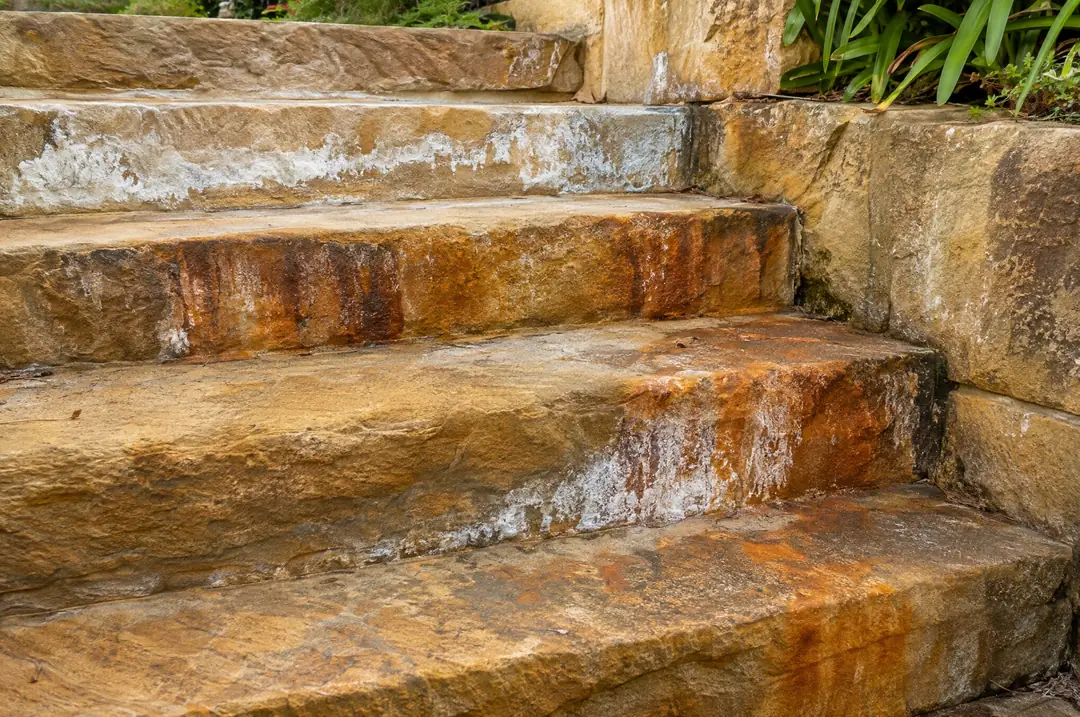
Efflorescence is a deposit of salt left on the surface of stone, brick, concrete or mortar when water evaporates. Water moving through the material dissolves soluble salts along the way. When it reaches the surface and dries, the water leaves but the salt stays, usually as a white, powdery or fluffy bloom.
Technical guidance from building researchers and installation-product makers agrees that three things have to come together for it to form: soluble salts, enough water to dissolve and carry them, and a way for that water to move to the surface and evaporate. Take away any one of the three and efflorescence stops. That is the most useful idea in this whole guide, because it explains both why the white powder keeps returning and what actually fixes it.
It is usually white, though BRANZ notes that deposits can occasionally be brown, green or yellow depending on the salts involved. It is most visible after a run of wet weather followed by warm, dry days, when water that soaked in during the rain is drawn back out. That timing is a useful clue: if white marks appear a few days after heavy rain or a pool party, efflorescence is the likely cause.
On its own, surface efflorescence is mostly a cosmetic problem. It is also a signal. It tells you that water is moving through your paving or wall and carrying salt with it, and that is worth understanding before you do anything else.
Where the salts come from on Sydney properties
- Cement-based bedding, mortar and grout. Portland cement products contain soluble salts. LATICRETE's technical data describes efflorescence from cementitious setting materials as a natural condition of those products rather than a defect in itself. The concrete slab under many paved areas is another source.
- Salt-chlorinated pools. Every splash leaves salt water to soak into coping and surrounding paving.
- Sea spray. Coastal homes in the Eastern Suburbs and on the Northern Beaches receive wind-blown salt year-round. BRANZ also lists coastal salt spray among the external sources.
- Soil and groundwater. Retaining walls and paving laid on the ground can draw moisture, and dissolved salts, from the soil behind or beneath them.
- Fertilisers and cleaning products. NSW heritage guidance on salt attack names inorganic garden fertilisers and cleaning compounds that contain or form salts among the sources of salt in masonry.
The water that carries these salts usually comes from a fixable source: paving without enough fall to shed rain, downpipes discharging onto stone, sprinklers, garden beds against walls, pool splash, or a slab with nowhere for trapped water to go.
New paving or an ongoing problem?
Efflorescence on newly laid stone is common and often temporary. LATICRETE separates primary efflorescence, which appears while the bedding and grout are drying and curing, from secondary efflorescence, caused by site conditions affecting the finished installation later on. Stone World notes that efflorescence frequently fades as salts work their way out of the setting system, though in some cases it persists.
The type of deposit matters too. BRANZ describes soluble efflorescence, which is powdery and brushes off easily, and an insoluble form that develops when lime from cement reacts with carbon dioxide in the air to form a hard calcium carbonate crust. The insoluble form becomes harder to remove the longer it is left, which is a good reason to deal with fresh efflorescence promptly.
New sealer can play a part. Dry-Treat notes that its impregnating sealer takes several weeks to fully bond inside the stone, and that salts may be pushed to the surface during that period. A light white bloom on freshly sealed paving is not necessarily a sign of a failed job.
Efflorescence or salt attack? Why the difference matters
Salt can crystallise in two places. When water evaporates slowly, crystals form on the surface as efflorescence. When it evaporates faster, the drying point sits just inside the stone and crystals grow within the pores. NSW heritage guidance calls this subflorescence and identifies it as the more damaging form. As crystals grow and shrink through cycles of wetting and drying, they push grains apart, and the surface frets away grain by grain or loses its outer skin entirely.
Signs that salt is working inside your stone include a sandy or sugary surface that rubs off on your hand, flaking or spalling, pitting along the waterline edge of pool coping, and joints that crumble. These are not cosmetic, and brushing off the surface powder won't stop them. They call for a proper assessment, and often for restoration as well as moisture control.
Is it efflorescence? Other white marks compared
Several different problems show up as white marks on paving. Treating the wrong one wastes time and can cause damage, so it is worth a careful look.
| Mark | Look and feel | Typical cause | Next step |
|---|---|---|---|
| Efflorescence | Powdery or fluffy; brushes off dry; returns after rain | Soluble salts carried by moisture | Dry brush, then find the water source |
| Calcium carbonate crust | Hard, chalky crust, often near joints; won't brush off | Lime from cement reacting with air | Specialist removal suited to the stone |
| Pool scale | Hard white lines where splash water dries | Calcium in pool water | Stone-safe descaling; never acid on travertine |
| Failed topical sealer | Milky, cloudy or peeling film | Moisture trapped under a coating | Strip, dry and reassess |
| Etching (travertine, limestone) | Dull, rough patches that don't wash off | Acid contact dissolving the surface | Honing, not cleaning |
| Lichen | Grey-white rosettes, firmly attached | Biological growth | Biocide treatment |
How to remove efflorescence safely
The gentlest methods are the right ones here, and they are well within a homeowner's reach for ordinary surface efflorescence.
- Wait for dry weather. Efflorescence is easiest to see and remove when the stone is dry.
- Dry brush. Use a stiff nylon or natural-bristle brush, not a wire brush, which scratches sandstone and can leave rust.
- Collect the salt. Sweep it up or vacuum it, and bin it. Heritage guidance stresses collecting salt-laden dust so it doesn't simply recirculate into the stone or nearby garden.
- Don't hose it off. BRANZ advises against washing efflorescence away with water, because water redissolves the salt and can carry it back into the stone. LATICRETE likewise warns that over-wetting promotes recurrence.
- Repeat as needed. On new paving, several rounds over a few months are normal as salts work out.
Be very careful with efflorescence removers. Many are acidic. LATICRETE's guidance is clear that acidic cleaners can alter acid-sensitive stone such as travertine, limestone and marble, and should be avoided there in favour of dry methods. On sandstone, Heritage Victoria's masonry guidance does not recommend mineral acids, which can attack the binder and leave salts of their own. Hard carbonate crusts and stubborn deposits are better left to a specialist who can test what will work on your particular stone.
For heavy salt loads in walls or coping, the conservation approach is a poultice: an absorbent paste of clay or paper pulp applied to the stone, left to dry, and removed with the salts it has drawn out. NSW heritage guidance notes that this can take more than one cycle and that each cycle needs time to dry fully.
Sandstone, travertine and pool coping: what differs
Sandstone paving and walls
Sandstone is porous and absorbent, so it takes in salt water readily and releases it slowly. Efflorescence tends to concentrate at the lower edge of walls, along joints, and on paving where water lingers. Because sandstone's binder is soft, it is also the stone most at risk when salt crystallises inside rather than on the surface. Dry methods and moisture control are the priority, and acids are off the table.
Travertine
Travertine is a form of limestone, so it is acid-sensitive. Many off-the-shelf efflorescence removers are acidic and will etch it, leaving dull marks that need honing rather than cleaning to fix. On travertine, efflorescence also collects in open holes where filler has washed out. Dry brushing, a vacuum with a brush head and patience are the safe approach. Our guide on how to clean travertine has more.
Pool coping
Coping around a salt pool is wetted and dried more often than any other stone on the property, so it is where efflorescence and salt attack appear first, usually along the waterline edge and the nose of bullnose pieces. White bloom on coping is worth watching closely. If it comes with pitting, flaking or a sugary edge, the salt is already working inside the stone. Regular freshwater rinsing, a salt-resistant penetrating sealer once the stone is clean and dry, and an annual water-drop test make a real difference. See how often to seal travertine for the travertine side of this.
Fixing the cause
Removal treats the symptom. BRANZ makes the point directly: if efflorescence keeps returning, water is still getting in. These are the checks we work through on site.
- Drainage and fall. Does rain run off the paving, or pond on it and soak in?
- Downpipes and gutters. Are any discharging onto stone or into the bedding beneath it?
- Garden beds and irrigation. Are beds built against walls, or sprinklers wetting stone daily?
- Pool splash. Rinsing salt water off coping with fresh water after heavy use reduces the salt load before it dries into the stone.
- Retaining walls. Is there drainage behind the wall, and are weep holes clear?
For new work, the installation is the best place to prevent efflorescence. Technical guidance points to setting and grouting materials low in soluble salts, membranes or barriers that stop water reaching the bed, and allowing each layer to dry properly before the next goes down.
Should you seal stone with efflorescence?
Not while it is active. Sealing over salts locks them in and can push crystallisation deeper into the stone. The order is: remove the surface salts, reduce the moisture, let the stone dry thoroughly, then seal.
Once those conditions are met, a breathable penetrating sealer can help, particularly around salt pools and on coastal terraces, because it reduces how much salt water enters the stone in the first place. Some manufacturers specifically describe their impregnators as protecting against efflorescence and salt spalling. Film-forming coatings are a different matter. They trap moisture and salt beneath them, which is why NSW heritage guidance warns against water-repellent coatings on damp masonry. Our guide Does sandstone need sealing? covers the decision in more detail.
DIY or specialist?
Dry brushing new paving and keeping an eye on it is a sensible job for any homeowner. We suggest calling a specialist if efflorescence keeps returning after the first months, if it has formed a hard crust, if the stone is travertine or limestone, if the surface is sandy, flaking or pitting, if the stone is heritage, or if it is pool coping showing damage at the edge.
Our stain removal service treats efflorescence and identifies its source, and pool coping work addresses salt exposure directly. Our vetted, insured technicians work across the Eastern Suburbs and Northern Beaches.
Sources
- BRANZ Bulletin 593, Efflorescence (2016)
- LATICRETE Australia, TDS-1159 Efflorescence: Causes, Prevention and Removal (2025)
- Stone World, Understanding and avoiding efflorescence (2006)
- David Young, Salt Attack and Rising Damp: A guide to salt damp in historic and older buildings (Heritage Council of NSW and partners, 2008)
- Heritage Victoria, Cleaning Masonry (2001), adapted from the Heritage Council of NSW's Cleaning Masonry Walls
- Dry-Treat, How to prevent efflorescence on limestone tiles (Spec-Net press release)
- Dry-Treat STAIN-PROOF Premium Impregnating Sealer, product information (distributor page)