The Prestige Standard stone-care team · Published 5 November 2026 · Updated 5 November 2026 · 8 min read
The three families at a glance
Every stone sealer either goes into the stone or stays on it. That one distinction explains most of the differences in appearance, grip, breathability and how the sealer eventually wears.
- Penetrating sealers, also called impregnators or impregnating sealers, soak into the pores and line them with a water- and oil-repellent layer. The surface looks and feels much as it did before.
- Enhancing sealers, also called colour enhancers or intensifiers, are penetrating sealers with added ingredients that deepen the colour, a little like the stone when it is wet, usually without adding gloss.
- Topical sealers form a film on the surface. Acrylics, polyurethanes, epoxies and many 'wet look' or gloss coatings fall into this group. They change the look and feel of the stone and wear from the top down.
The Natural Stone Institute notes that most sealers used in the stone industry today are impregnators, which repel stains rather than truly 'sealing' the stone. That is a useful reminder: no sealer makes stone stain-proof. A good one gives you time to clean up a spill before it soaks in.
Side-by-side comparison
| Penetrating (natural) | Enhancing | Topical (film-forming) | |
|---|---|---|---|
| Where it sits | Inside the pores | Inside the pores | On the surface |
| Appearance | Little or no change; some stones darken slightly | Deeper, richer colour; usually no gloss | Satin to high gloss; often a 'wet' or plastic look |
| Breathability | Generally vapour-permeable | Generally vapour-permeable | Restricts moisture leaving the stone |
| Effect on grip | Little change to texture | Little change to texture | Can become slippery when wet |
| How it wears | Gradually, from the surface inwards | Colour effect can fade before protection does | Scuffs, peels, clouds or yellows on the surface |
| Re-application | Clean, dry, re-apply same product | Clean, dry, re-apply; test colour match | Often requires stripping before re-coating |
| Can it be undone? | Wears away over time | Colour change persists until it wears | Removal needs chemical strippers |
| Typical uses | Pool coping, terraces, walls, interiors | Feature paving, tumbled travertine, sandstone where a deeper tone is wanted | Some interior surfaces; rarely suited to outdoor natural stone |
Individual products vary, so the manufacturer's technical data sheet for the exact product always takes precedence over a general table like this one.
Penetrating sealers in more detail
Most professional impregnators are based on silane, siloxane or fluoropolymer chemistry, often in combination. They are carried into the stone by a solvent or water, which then evaporates and leaves the active ingredients bonded inside the pores.
The main advantages for outdoor stone are:
- Breathability. Dry-Treat, for example, describes its STAIN-PROOF impregnator as letting vapour pass through the treated stone so moisture does not build up inside it. That matters on paving laid on damp ground and on coping that is constantly wetted.
- Natural look and grip. FILA describes its MP90 Eco Plus as not forming a film and not altering the material's natural look. Because there is no coating, the texture underfoot is largely unchanged.
- Salt resistance. By keeping water out of the pores, a good impregnator slows salt getting into the stone. It does not make stone immune; Dry-Treat says plainly that sealing makes stone more resistant to salt, not salt-safe.
Their limits are worth knowing too. Penetrating sealers do not stop acids etching travertine or limestone, which FILA, Aqua Mix and Dry-Treat each state in their own product literature. Some stones darken slightly even with a 'natural' product, which is why manufacturers recommend a test area first. And because they need to get into the pores, they only work on clean, dry, unsealed stone.
Enhancing sealers in more detail
An enhancer is a penetrating sealer with a cosmetic job as well. It deepens the stone's colour and brings out the veining, banding and contrast, particularly in honed and tumbled travertine and in sandstone's honey and ochre tones.
Lithofin describes its MN Colour Intensifier as a siloxane impregnator that deepens colour without gloss and does not form a surface layer, so slip resistance is hardly affected. Aqua Mix describes Enrich 'N' Seal as a no-sheen penetrating sealer that darkens and highlights stone and allows moisture vapour through.
Things to weigh up before choosing one:
- The change is real and lasting. Once applied, the deeper tone stays until the product wears. If you are not sure, a test patch on a spare paver or hidden corner is essential.
- Colour can fade before protection. Lithofin says the colour effect of its intensifier lasts roughly one to two years outdoors, while protection lasts several years. Expect to top up an enhancer on exposed areas.
- It suits textured finishes best. Lithofin advises against its intensifier on polished or very finely honed stone.
- Wear shows. On heavy traffic paths, uneven fading can make the walking line paler than the edges.
Enhancers are a matter of taste rather than performance. We show clients both natural and enhanced test patches on their own stone before deciding.
Topical sealers, and why we avoid them outdoors
Topical sealers create a film that you can see and feel. Indoors, on some stone and in some settings, a film finish has its uses. Outdoors on sandstone and travertine, it causes most of the sealing problems we are called to fix.
- Trapped moisture and salt. Outdoor stone takes in water from below and the sides as well as from the top. A film restricts that moisture from escaping, and when it carries salt, the salt can crystallise under the coating. Industry guidance on saltwater pools stresses breathability for exactly this reason.
- Peeling and clouding. Trapped moisture lifts the film. Stone Doctor's guide to stone sealers lists delamination and peeling among the common failures of topical products.
- Slip. A smooth film over textured stone can reduce grip when wet, which matters around pools and on steps.
- UV and wear. In our experience, many film-forming coatings dull, scuff or yellow under Australian sun and foot traffic, and wear unevenly.
- Removal. A failed film has to be stripped before any penetrating sealer can be applied. That is often the most expensive part of putting things right. See our guide to sealing costs.
If your stone already has a glossy or peeling coating, our restoration service covers strip testing and removal.
Slip resistance: what the standards say
Slip resistance of pedestrian surfaces in Australia is measured and classified under AS 4586, and Standards Australia's handbook SA HB 198 gives recommended minimum ratings for different locations. According to ACO's technical summary of the 2013 and 2014 editions, the wet pendulum test rates surfaces from P0 to P5, and the handbook recommends at least P4 for swimming pool surrounds, with P5 for ramps and stairs leading into the water.
Any treatment can change how a surface performs, so it is reasonable to ask a sealer supplier for slip test data on the product and stone in question. Penetrating sealers that leave no film generally have little effect: Lithofin says slip resistance is hardly affected by its intensifier, and a Dry-Treat case study on a travertine pool surround reports wet-slip resistance unaffected by the sealer used. Film-forming coatings are the ones most likely to change it.
Whether a particular slip rating is required for your project is a question for your designer, builder or certifier; the handbook itself is guidance. Our regulations page covers the wider NSW context.
Water-based or solvent-based?
Within penetrating and enhancing sealers there is a second choice: the carrier. Solvent-based products often penetrate dense stone well and suit some applications where maximum water repellency is needed; Lithofin, for example, recommends its solvent-based version over its water-based one for dense limestone and showers. Water-based products have lower odour and VOCs and are easier to use around occupied homes and gardens.
Solvent-based sealers need careful handling. Lithofin's safety information for its intensifier lists flammability, skin irritation and harm to aquatic life, and calls for good ventilation and protection of nearby glass, timber and plastics. This is one of the reasons sealing large areas is often better left to a professional.
How to tell what is already on your stone
Before choosing a sealer, it helps to know what, if anything, was used before. Many homeowners inherit stone with no record of its treatment. A few simple observations narrow it down:
- Look at the sheen. If the stone has a gloss or satin shine that natural sandstone or honed travertine would not have, there is probably a topical coating on it.
- Look for peeling or white patches. Flaking edges, cloudy or milky areas and a 'tide line' where the finish stops are classic signs of a failing film.
- Feel it. A coating often feels smooth or slightly plastic compared with the grain of bare stone.
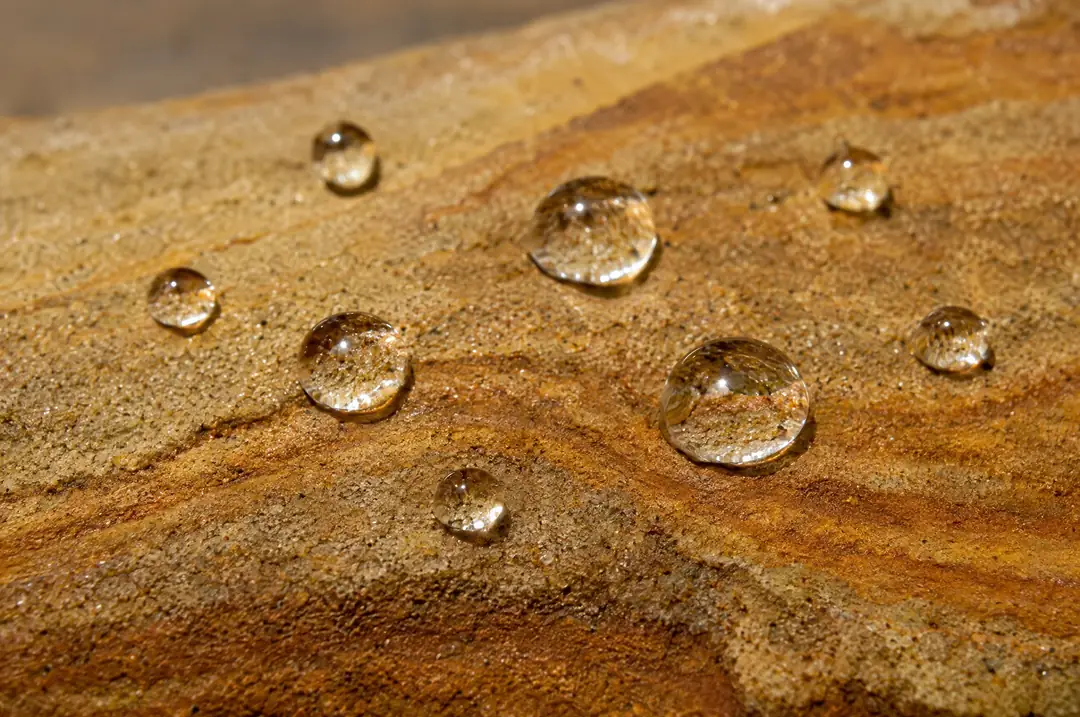
- Do the water-drop test. Beading on a matte surface with no visible film usually indicates a penetrating sealer still working. Water soaking in suggests the stone is unsealed or the sealer has worn through.
- Check the colour. Stone that looks permanently darker than an offcut or a hidden area may have been enhanced.
If you are unsure, a technician can confirm on site with a small strip or solvent test. Getting this right matters, because a new penetrating sealer cannot get through an old film.
Questions that settle the choice
For most of our clients, three questions decide the sealer:
- Do you want the stone to look the same, or richer? Same means a natural impregnator. Richer means an enhancer, after you have seen a test patch.
- How harsh is the exposure? Salt pools, sea spray and full sun call for a product suited to those conditions and a more frequent testing routine.
- Will people walk on it barefoot or when wet? If so, avoid anything that forms a film, and keep the stone's natural texture.
Budget and maintenance follow from those answers rather than leading them. A well-chosen penetrating sealer on properly prepared stone is usually the lowest-maintenance option over time.
Matching the sealer to the surface
- Travertine pool coping and surrounds: a breathable penetrating impregnator suited to salt exposure, natural or enhancing. Never a film. See pool coping.
- Sandstone paving and steps: a penetrating sealer suited to porous stone, natural or enhancing. See sandstone sealing.
- Sandstone walls and heritage stone: often best left unsealed so they can breathe freely; where protection is needed, a breathable impregnator only. Our guide does sandstone need sealing? explains when.
- Tumbled or honed travertine terraces: natural or enhancing penetrating sealer, after holes are filled. See travertine sealing.
- Bluestone, limestone and granite: each needs its own product and test. See natural stone sealing.
Always test first
Every manufacturer we reviewed, including Lithofin, FILA, Aqua Mix and Dry-Treat, recommends a test application before treating a whole area. The test confirms the colour change, how much product the stone absorbs and how it feels underfoot once cured. Allow the test to cure fully before judging it; Dry-Treat suggests a 24-hour cure for its test areas.
If you would like to see natural and enhanced finishes side by side on your own stone, our technicians work across the Eastern Suburbs and Northern Beaches. Contact us to arrange a visit.
Sources
- Natural Stone Institute: Care and cleaning of natural stone
- Dry-Treat: STAIN-PROOF impregnating sealer product information (Kebur)
- Spec-Net: Salt resistant sandstone or limestone with Dry-Treat
- Spec-Net: Travertine sealer case study, Dry-Treat
- FILA: MP90 Eco Plus technical data sheet
- Lithofin: MN Colour Intensifier technical information
- Lithofin: MN Stain-Stop >ECO< technical information
- Aqua Mix: Enrich 'N' Seal technical data sheet (TDS-160)
- ACO: Understanding slip resistance (AS 4586 and SA HB 198)
- Litos: Treatment of natural stone in saltwater pools
- Stone Doctor: Guide to natural stone sealers