The Prestige Standard stone-care team · Published 5 November 2026 · Updated 5 November 2026 · 9 min read
What etching is
Travertine is a form of limestone, and like marble and other limestones it is made mainly of calcium carbonate. Calcium carbonate reacts with acid. When something acidic touches the stone, it dissolves a very thin layer of the surface. The polished or honed finish in that spot is replaced by a slightly rough, microscopically pitted surface that scatters light differently from the stone around it. That is an etch mark.
The Natural Stone Institute groups stones into two families: calcareous stones such as marble, limestone, travertine and onyx, which are mainly calcium carbonate and sensitive to acids, and siliceous stones such as granite, which are mainly silicate minerals and generally resist everyday acids. Travertine sits firmly in the first group.
Common causes of etching we see on Sydney properties include:
- wine, citrus, soft drinks, cocktails and tomato-based food on entertaining terraces and kitchen floors;
- vinegar-based or citrus-scented household cleaners, bathroom descalers and general tile cleaners;
- pool acid splashed during dosing, and pool water that has been allowed to run at low pH;
- acidic mortar and grout haze removers used during installation or renovation;
- rust removers and some toilet and drain cleaners, which can contain strong acids.
Strong acids etch in seconds. Milder ones, such as a glass of wine left overnight, take longer but leave the same kind of mark.
Etching or staining? How to tell the difference
Etching and staining are often confused, and they need opposite treatments. A stain is something added to the stone: coloured liquid, oil or mineral that has soaked into the pores. An etch is something taken away from it. Stains are drawn out. Etches are ground back.
| Sign | Etch mark | Stain | Surface deposit (scale, soap, residue) |
|---|---|---|---|
| Colour | Lighter, duller or whitish, the same colour family as the stone | Usually darker or a distinct colour: brown, orange, grey or green | White, cloudy or filmy |
| Feel | Slightly rough or less smooth than the surrounding stone | Same feel as the surrounding stone | Often raised, chalky or tacky |
| Shape | Follows the spill: drips, rings, splash patterns, wipe marks | Follows the spill or object, often with soft edges | Where water evaporates or product was left |
| Response to cleaning | No change | May lighten with the right cleaner or poultice | Usually comes off with the right cleaner |
| Fix | Honing or, indoors, re-polishing | Poultice matched to the stain | Appropriate stone-safe cleaner |
A simple check: clean the area with a pH-neutral stone cleaner, rinse and let it dry. If the mark is still there, run your fingertip from the good stone across the mark. A change in texture, or a dull spot that catches the light at a low angle, points to etching. A darker mark with no change in texture points to a stain. Stone guides such as Slabwise put it neatly: etches tend to look light and dull, and stains tend to look dark.
On honed and tumbled outdoor travertine, light etching can be hard to see at all until the low afternoon sun hits it. Pool scale also confuses things, because the hard white deposits left by evaporating pool water often sit on top of etched stone. Our guide to cleaning travertine covers deposit removal without acid.
Why sealing doesn't stop etching
This is the most common misunderstanding we meet. Many owners are told their travertine is sealed and assume it is protected from acid. It isn't.
The sealers used on outdoor travertine are penetrating impregnators. They line the pores and make the stone repellent, which slows how quickly water, oil and coloured liquids soak in. That gives you time to clean up a spill before it becomes a stain. But an acid doesn't need to soak in to cause damage. It reacts with the calcium carbonate at the surface on contact, and the impregnator in the pores below does nothing to prevent that reaction.
The manufacturers and distributors say so directly. Stone Doctor, an Australian stone-care supplier, notes that acid etching still occurs on marble sealed with an impregnating sealer. Dry-Treat's UK distributor states that its STAIN-PROOF impregnator does not prevent etching, scuffing or wear. The Natural Stone Institute describes sealers as repellents that make stone more stain-resistant, not stain-proof, and certainly not acid-proof.
So why seal at all? Because outdoors, staining and salt are the bigger long-term threats. A good penetrating sealer slows salt water entering pool coping, keeps food oils and leaf tannin at the surface, and makes routine cleaning easier. It just isn't etch protection. Our guide to how often to seal travertine explains how to check whether yours is still working.
Topical coatings that form a film on the surface can shield stone from brief acid contact, which is why they are sometimes used indoors. Outdoors, and particularly around pools, film-forming coatings tend to trap moisture and salt, wear unevenly and become slippery when wet, so we don't recommend them. Our comparison of penetrating, enhancing and topical sealers covers the trade-offs.
How etch marks are removed: honing
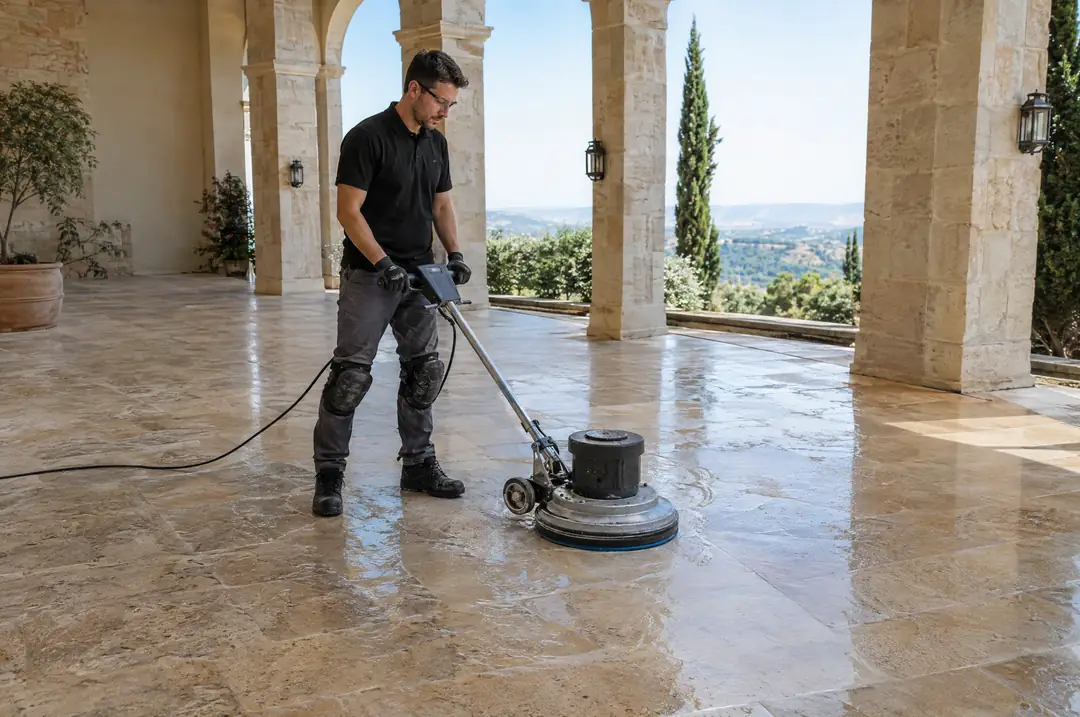
Since etching is a loss of surface, the only real fix is to bring the surrounding surface down to the same level, so the whole area is even again. That is what honing does. Diamond abrasive pads on a rotary machine, used wet, remove a very fine layer of stone, working from a coarser grit to finer ones until the scratches from each stage are removed by the next.
Light etching
Very light etching on honed travertine can sometimes be blended with a honing powder. Aqua Mix, for example, sells a non-acidic honing powder intended for light scratches, moderate etching and wear paths on marble, limestone and travertine, producing a flat, honed finish. The Natural Stone Institute describes a similar approach with polishing powder for etched marble indoors, worked in with a damp cloth or a low-speed pad. These products are useful for a small spot, but they leave the finish of the product, not necessarily the finish of your stone. Used on part of a floor, they can create a patch that looks different from everything around it.
Moderate to heavy etching
Widespread etching, deep marks from pool acid, or a surface damaged by a previous acid wash needs machine honing. A technician tests how deep the damage goes and chooses a starting grit to suit. Starting too fine wastes time without removing the etch. Starting too coarse removes more stone than necessary and leaves scratches that take longer to refine.
Filling and finishing
Honing often opens up natural holes in travertine that were previously filled or bridged. These are refilled with a colour-matched filler before the final passes, then the surface is cleaned, allowed to dry and sealed. Freshly honed stone is at its most absorbent, so sealing promptly matters.
| Damage | Typical repair | DIY suitability | Notes |
|---|---|---|---|
| Single light etch on honed stone | Honing powder, worked by hand | Possible with care | Test first; may leave a slightly different sheen |
| Light etching on a polished indoor floor | Polishing compound or powder | Small spots only | Results vary by stone; larger areas need a machine |
| Spill marks across a terrace | Machine honing of the affected area or whole surface | Not recommended | Whole-area honing gives the most even result |
| Heavy etching from acid washing or pool acid | Staged diamond honing from a coarser grit | No | Holes often need refilling |
| Etching plus salt damage at pool edges | Honing, repair or replacement of damaged pieces | No | Sealing afterwards slows further salt attack |
Indoor and outdoor finishes behave differently
The finish doesn't change the chemistry. Polished and honed travertine etch at the same rate. What changes is how visible the damage is and how it should be repaired.
Polished travertine, usually found indoors, shows etching most clearly because the dull mark contrasts with a glossy surface. Repair means honing out the etch and then re-polishing through progressively finer stages so the sheen matches. It looks spectacular, but it will show every future spill, so households that entertain often may prefer a honed finish.
Honed travertine has a smooth, matte to satin finish. Etches are still there, but they are much less noticeable because the surface already diffuses light. Honed surfaces are a little more absorbent than polished ones, so sealing matters more for stain resistance.
Tumbled and brushed travertine, common on pool surrounds and terraces, hides light etching well thanks to its textured surface. Heavy etching still roughens and pales it. Honing tumbled stone flat changes its character, so it's worth discussing the look you want before machine work.
Outdoors, we finish at honed rather than polished. A polished surface outdoors wears quickly under grit and shoes, shows etching from pool water, and is more slippery when wet. Standards Australia's handbook HB 198 recommends minimum slip-resistance classifications for different locations, including pool surrounds. Whether a particular rating applies to your project is a question for your designer, builder or certifier, and our regulations page summarises the background.
Preventing etching
Etching is far easier to prevent than to repair. The habits that work are simple.
- Clean with pH-neutral stone cleaner only. Avoid vinegar, lemon, bathroom descalers, general tile cleaners and anything that fizzes on stone. Make sure cleaners and housekeepers know this too.
- Blot spills quickly. Wine, juice and cocktails should be blotted, not wiped, then rinsed with clean water.
- Use trays and coasters on outdoor tables and bar areas, and keep citrus and condiments on boards rather than directly on stone.
- Keep pool chemistry in range. Low-pH pool water etches coping and surrounds over time. When dosing acid, pour carefully away from the coping and rinse any splashes straight away.
- Brief your trades. Tilers, pool technicians and builders sometimes reach for acid-based cleaners out of habit. Tell them the stone is travertine before they start.
- Rinse coping after heavy use. Fresh water reduces salt build-up and dilutes anything acidic left behind.
What you can do yourself
There is a sensible DIY path for minor marks. Start by cleaning the area with a pH-neutral stone cleaner and letting it dry, so you can see whether the mark is an etch or a deposit. If it's a single light etch on honed stone, a honing powder made for limestone and travertine, used strictly to the label on a small test spot first, may blend it acceptably.
What not to do:
- Don't use sandpaper or abrasive pads from the hardware store. They scratch unevenly and leave a patch that's harder to blend.
- Don't try to polish outdoor travertine to hide etches. You'll create a shiny, more slippery patch that etches again.
- Don't apply more sealer or an enhancer to disguise etching. It may darken the area temporarily, but the etch remains.
- Don't use acid to remove pool scale from etched coping. It will deepen the etching.
If the marks cover more than a small spot, or the result of a test doesn't blend, stop there.
When to call a specialist
Machine honing is the right call when etching covers a large area, follows traffic paths, sits around a pool edge, or came from an acid wash. It is also worth getting advice when etch marks sit alongside flaking, pitting or a sugary surface, which usually signals salt damage as well as acid. Our guide to salt attack on pool coping covers that combination.
Our travertine honing service starts with a test to judge how deep the etching goes, then staged diamond honing with the slurry contained and recovered, refilling of exposed holes, and a final clean. We follow it with travertine sealing once the stone is dry. If the marks turn out to be scale or residue rather than etching, a travertine clean may be all that's needed, and for pool edges our pool coping service brings it all together. We work across the Eastern Suburbs and Northern Beaches. Send photos taken in low, angled light through our contact page and we can usually tell you whether you're looking at etching, staining or both.
Sources
- Natural Stone Institute: Care and cleaning of natural stone
- Natural Stone Institute: Stain identification and removal (including etch marks)
- Slabwise: Which stones are most prone to etching
- Stone Doctor Australia: What is acid etching on marble?
- Dry-Treat: STAIN-PROOF impregnating sealer product information (Kebur)
- Aqua Mix: KnockDown honing powder (Custom Building Products)