Sandstone cleaning and sealing in Queenscliff
Queenscliff sandstone takes salt from the surf every day. We remove it without opening up the surface, and seal where a sealer will keep more salt out.
- Queenscliff 2096
- $20 million public liability
- Price on request
Sandstone in Queenscliff usually belongs to an apartment building: a front boundary wall, entry steps, planter walls in a shared courtyard, sometimes cladding around a lobby door. On houses nearer the headland it appears as garden walls and terraces. The closer it is to the beach, the more likely it is to feel gritty to the touch, carry a pale crust in dry weather and shed grains when brushed. Shaded courtyards behind the buildings add mould and algae. Our technicians record which areas show salt damage, which show growth and which are simply dirty, and test cleaners on each, because one approach rarely suits all three in the same building.
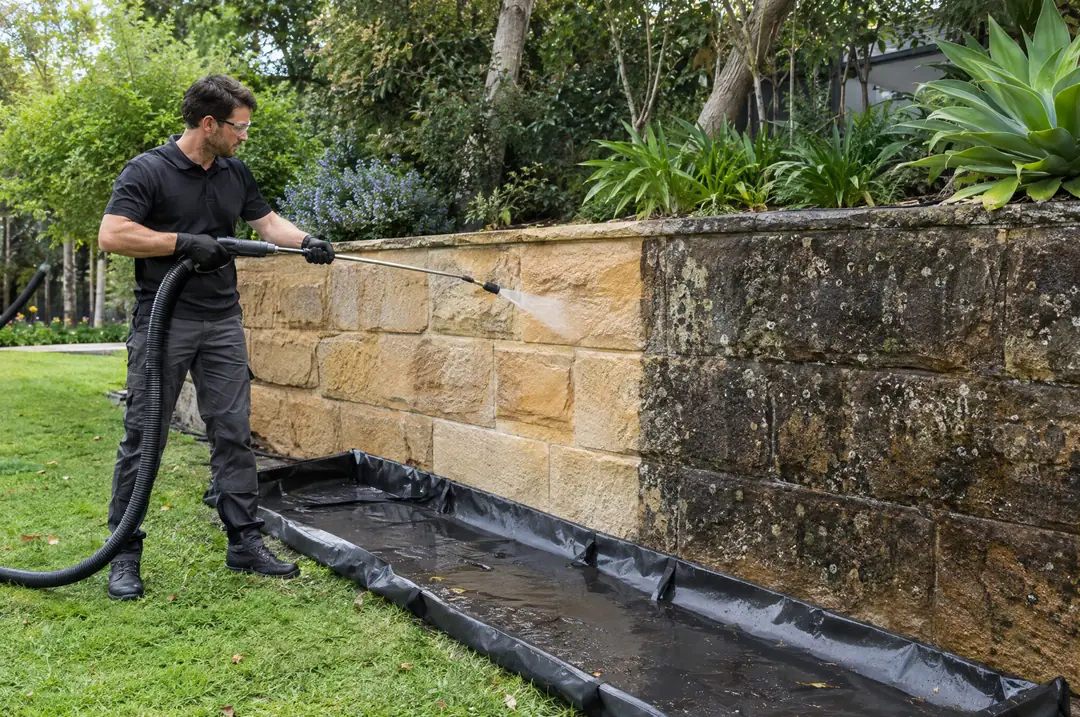
Salt-damaged sandstone is fragile, so cleaning starts dry. Loose salt and sand come off with brushes and a vacuum before the hose is even unrolled, which stops dissolved salt being pushed back into the stone. Growth is treated with a biocide suitable for porous stone and given time to work. Rinsing uses a broad, gentle spray, and never a turbo tip, which would strip the weakened surface. On beachfront properties the boundary is bunded and wash water is sucked up as we go, so it stays off the sand and out of drains that run to the beach. Common areas stay usable throughout, with clear signage on any section that is still wet.
Sealing can make a real difference on salt-exposed stone, provided it is the right kind. A breathable impregnator cuts the amount of salty water entering the pores while still letting moisture inside escape, so the stone dries without trapping salt. Film-forming coatings do the opposite and can cause blistering and peeling on walls this close to the surf. Retaining walls and planters holding soil are left unsealed. Application happens only once the stone is completely dry and on a day without onshore wind, and it goes on in thin coats that leave no surface film. For strata committees we provide a written record of products, areas treated and a suggested inspection interval.
Frequently asked questions
Sandstone questions we hear in Queenscliff.
Can you remove old sealer that is peeling off our front wall?
Often, yes, using a stripper suited to the coating and a gentle rinse. It is slower than a standard clean. Once removed, a breathable sealer can be applied if the stone is in good condition.
How often should beachfront sandstone be checked?
We suggest a look every year, with a professional clean every one to three years depending on exposure. A water-drop test shows whether the sealer is still doing its job.
Will cleaning make salt-damaged stone worse?
Not with a gentle method. Dry brushing, low pressure and careful rinsing remove salt without stripping the surface. Badly eroded stone may need a stonemason, and we say so before cleaning.
Can you work while residents are coming and going?
Yes. We section off areas, keep a dry route open and put up signage. Larger common areas can be staged over more than one day.