Sandstone cleaning and sealing in Vaucluse
Vaucluse sandstone deals with salt from two directions and leaf litter from the reserves. We treat the growth, rinse gently and seal only where it will help.
- Vaucluse 2030
- $20 million public liability
- Price on request
The sandstone on a Vaucluse property usually tells you which way it faces. Walls on the harbour side carry a thin grey crust of salt and grime, often with a green tinge where garden irrigation reaches them. Stone toward Diamond Bay shows more flaking, because spray off the ocean drives salt further into the pores. Under the canopy near Nielsen Park and the Hermitage foreshore, steps and paths go black with mould and brown with leaf tannin, and they stay slippery for days after rain. Each of these needs its own cleaner and dwell time, which is why our technicians begin with a small test area on your stone rather than one standard mix for the whole property.
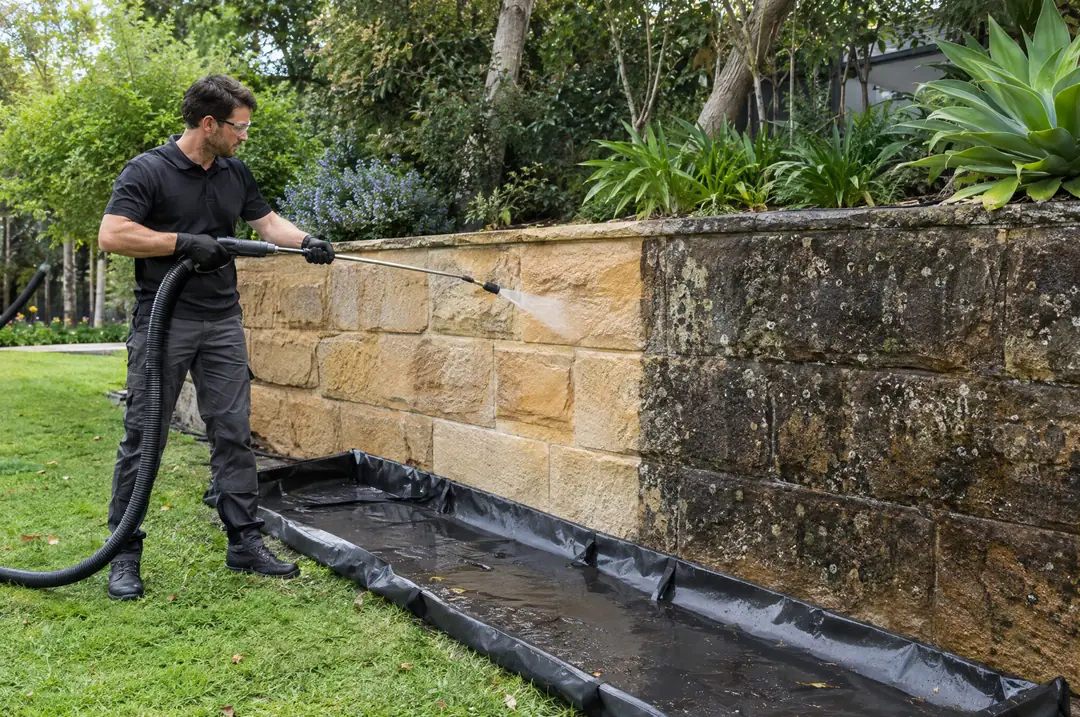
Cleaning in Vaucluse is about lifting growth and deposits without opening up the face of the stone. Organic growth is treated with a stone-safe biocide and given time to work, so it dies back at the root instead of regrowing within a season. Salt deposits are brushed off dry first, then softened and rinsed away with fresh water. The final rinse is low-pressure or controlled hot water, never a turbo tip, because weathered sandstone on older garden walls is already soft and loses grains easily. Wash water is bunded at the low side of the block and vacuumed up, which matters on the many sites here that drain straight down toward the harbour.
Whether to seal depends on the individual piece of stone. Paving, garden stairs and pool coping that take regular salt and foot traffic usually benefit from a breathable penetrating sealer, which lets water bead off while moisture inside can still escape. Freestanding walls in sound condition are often better left unsealed, and walls holding back soil almost always are. We apply a natural finish and an enhancing finish side by side on your stone so you can compare them in daylight, then log the product, the date and the areas treated. For ocean-facing stone we suggest a water-drop test every year; sheltered harbour paving can usually go longer between checks.
Frequently asked questions
Sandstone questions we hear in Vaucluse.
Why is the sandstone on the ocean side of our house flaking more than the rest?
Wind-driven spray from the ocean carries more salt into the pores, and as it dries the crystals push grains off the surface. Cleaning off the salt and sealing suitable areas slows this; badly eroded stone may need a stonemason.
Can you clean the sandstone steps down to our boatshed?
Usually, if access is safe and we can stop run-off reaching the water. We look at the steps first, because stone in the wave zone may be loose or undermined, and structural repairs need a marine contractor.
Is a natural or enhancing sealer better for Vaucluse sandstone?
Both work on salt-exposed stone. Natural keeps the colour you have now; an enhancer warms and deepens it. We apply test patches of each so you can decide on your own stone.
Our gardener uses a pressure washer on the paths. Is that a problem?
It can be. A close high-pressure tip erodes sandstone and leaves a sanded surface that gets dirty faster. A wide fan at low pressure, or simply sweeping and an occasional professional clean, is far kinder to the stone.